-
×
 SANYO Cassette Radio Marketing Brochure 58-01
1 × 79.99€
SANYO Cassette Radio Marketing Brochure 58-01
1 × 79.99€ -
×
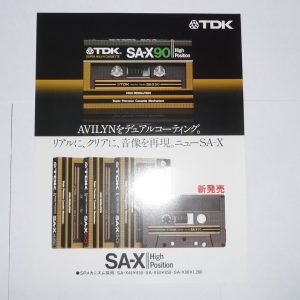 TDK SA-X Audio Cassette Marketing Brochure
1 × 9.99€
TDK SA-X Audio Cassette Marketing Brochure
1 × 9.99€
Subtotal: 89.98€


1 in stock
TDK FOR MASTERING USE MARKETING BROCHURE 4 PAGES IN JAPAN
9.99€
1 in stock
Model: GX, LX
No:
Year: 1981-2
Type: Marketing Brochure
Delivery: By registered post
Availability: 1
Language: Japan
Format: Original
TDK MA60
Brand New
Metal
“Type IV” tapes using pure metal particles (as opposed to
oxide formulations) were introduced in 1979 by 3M under
the trade name Metafine.
The metal-formulated audio cassette hit the scene as the
answer to a number of problems with previous tape
formulations. The standard Ferric-oxide (Type I) tape had
typically rendered poor high frequency definition.
Two subsequent solutions had been developed: the first
(Type Il) being a chrome (CrO2) Formulation, which rendered
much better frequency reproduction and very low noise
(hiss) at the expense of some output level and low-frequency
solidity. The second solution, ferro-chrome (Type II), was an
attempt to restore some low-frequency firmness to the
bright and airy sound of chrome, by adding a second coating
layer (ferric) to the existing chrome formulation. Fundamentally,
it was a technically imperfect innovation, and it wasn’t
significant enough an improvement over standard chrome.
Enter the Type IV tape, with a completely new formulation,
of metal particles. The advantages were quickly recognized.
This was a very hard-wearing tape, which could take much
higher sound levels than a chrome, whilst reproducing equal
or better high frequency definition, and a firmer bass — but,
without losing the spacious midrange in the way Ferro-
chromes could.
The disadvantages were quickly recognized too;
excess wear on the tape heads, and excess cost in the
retail price being the most significant. In order to get 20%
better sound, you have to spend 80% more.
The metal audio tape was, however, considered worth
persevering with. Efforts were made to solve the problem
of wear, and in the course of the early 1980s the Type IV
cassette did start to catch on.
By the mid 1980s, metal tapes had been adopted by a lot
of enthusiasts, but they remained too expensive to be bought in
bulk by the average consumer.
Metal cassettes (IEC Type IV) also use 70 µs equalization.
TDK MA-R90
Brand New
What difference is there between TDK MA and TDK MA-R?
Both cassettes have exactly the same metal tape.
The only difference is in the cassette housing and mechanism. TDK MA is housed in a moulded case with the much acclaimed TDK Laboratory Standard Mechanism. It will give superb and reliable results over and over again. The R in MA-R stands for TDK’s Reference Standard and refers to the cassette mechanism. Reference Standard means of such a recognisably high standard that it is used as the basis by which other TDK cassette mechanisms are judged. To achieve this standard, the cassette mechanism is built of a three layer construction with a die cast zinc core machined to micron tolerances. The advantages of this unique construction are total stability with accurate left to right channel orientation and true parallel running of the A and B sides. It has been developed to take the fullest possible advantage of the qualities of metal tape, thus producing the ultimate in hi-fidelity.




There are no reviews yet.